
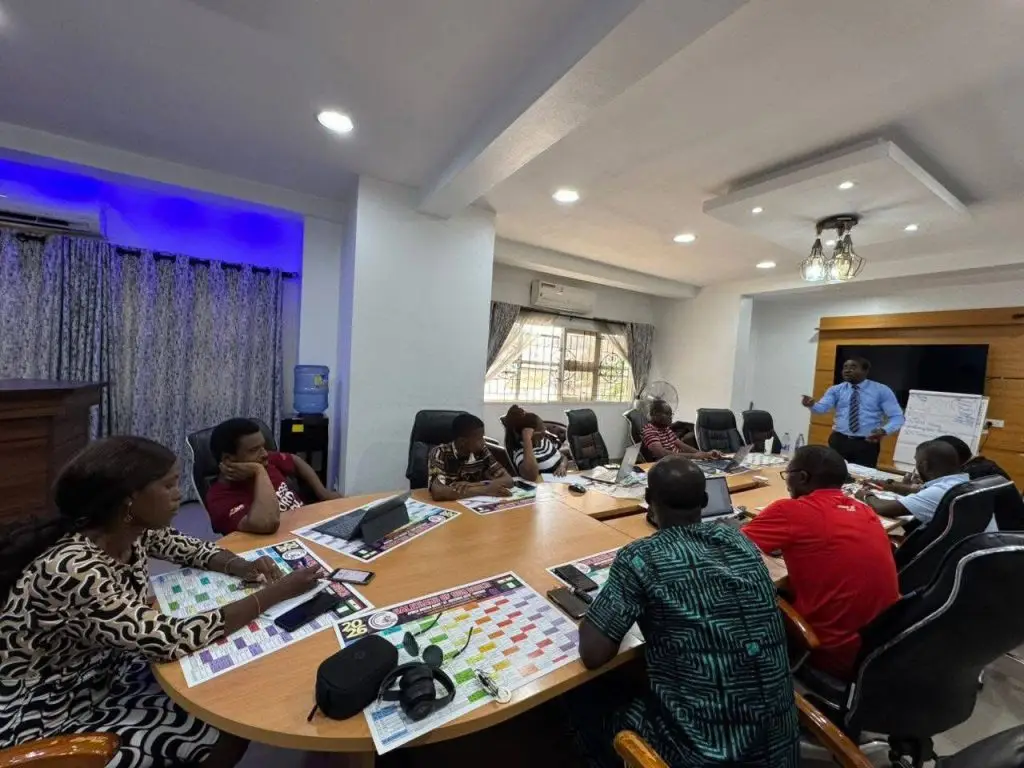
In preparation for the new work year, the Project Development Office(PDO) of the Salesians of Don Bosco, ANN Province, held a training session on the new Nigerian tax law, which became effective on 1 January 2026. The training took place on 8 January 2026 and brought together members of the PDO team, as well as economers and accountants from neighbouring communities including Onipetesi and Ijebu Ode.
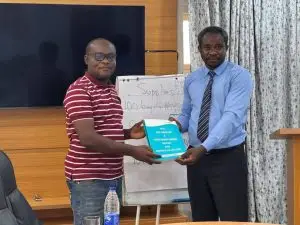
The session was facilitated by Mr. Sam, a taxation expert and author of several finance and taxation books. His presentation focused on helping participants clearly understand the new law and its practical implications for the work of the PDO and the ANN Province.
Understanding the New Tax Law
Mr. Sam explained that while many versions of the tax reform are circulating online, only one version is legally valid. According to him, the authoritative document is the one published on the website of the Presidential Fiscal Policy and Tax Reforms Committee, marked “Extraordinary” and “Official Review.” This is the version that will be applied by the Nigeria Revenue Service (NRS) and all state internal revenue services.
Key Focus: Payroll and Employee Taxation
Because the Salesians of Don Bosco operate as a humanitarian and non-profit organisation, the training focused mainly on PAYE (Pay As You Earn) and employee taxation, rather than company income tax.
Participants learned how tax is calculated using a clear flow:
Total Income (TI) = Taxable Income (Tax_In) – Total Deduction (TD)
Chargeable Income (CI) =Total Income (TI) – Eligible Deductions (ED)
Mr. Sam highlighted that employees earning the minimum wage or below (₦70,000 monthly or ₦840,000 annually) are fully exempt from tax under the law. For employees earning above this threshold, Nigeria operates a progressive tax system, where higher income attracts higher tax rates.

Eligible Deductions and Tax Bands
The training explained the six eligible deductions allowed before tax, including pension, NHIS, National Housing Fund contributions, life insurance, rent relief, and mortgage interest. Emphasis was placed on proper documentation, as deductions can only be applied when supported with evidence.
Using a simple example, participants saw how deductions affect an employee’s chargeable income and how tax is applied across the progressive bands, with the first ₦800,000 taxed at 0%.
VAT, Withholding Tax, and Humanitarian Exemptions
The session also covered VAT and Withholding Tax, explaining how VAT is calculated using input and output VAT, and clarifying that VAT is ultimately paid by the consumer.
Of particular relevance to the PDO was Section 186 of the Tax Act, which provides VAT exemptions for goods and services purchased for donor-funded humanitarian projects. Mr. Sam stressed the importance of keeping proper records and, where necessary, obtaining official exemption letters from the tax authorities.
Participants were also guided on withholding tax rules, noting that only registered companies are authorised to withhold tax, and that the current Withholding Tax Regulations became effective on 1 January 2025.
Strengthening Compliance and Good Practice
The training concluded with practical steps for compliance, including timely remittance of PAYE deductions by the 10th of the following month, annual PAYE filings by 31 January, and the need for proper tax identification and documentation.
The session equipped participants with practical knowledge to ensure compliance with the new tax law while safeguarding the humanitarian mission of the Salesians of Don Bosco. It also reinforced the PDO’s commitment to transparency, accountability, and responsible stewardship as it begins the 2026 work year.